


10G SFP+ AOC Buying Tips for Global Buyers?
Global buyers need more than a low price when selecting 10g Sfp+ Aoc cables. They need stable links, verified compatibility, and predictable delivery. A small data-center row may contain hundreds of connections, each running between switches, servers, and storage systems. One unsuitable cable can create intermittent errors, extra troubleshooting, and costly downtime.
Recent reports support this cautious approach. LightCounting’s Optical Communications Market Forecast identifies data-center expansion and AI infrastructure as major drivers of optical demand. Dell’Oro Group’s data-center research also shows continuing investment in higher-speed Ethernet networks. These trends keep 10GbE relevant, especially for existing enterprise networks and cost-sensitive upgrades. However, market growth does not guarantee equal product quality. That is where buyers must look harder.
Andrew Schmitt, Research Director at Cignal AI, has highlighted that AI infrastructure is creating exceptional pressure across the optical supply chain. His warning is practical: demand can grow faster than dependable component availability. Buyers should therefore check transmission distance, multimode-fiber compatibility, connector polish, EEPROM coding, operating temperature, and test documentation. Ask for real test results, not only a product photograph. Confirm whether the AOC works with the exact switch and NIC models. Vendor compatibility lists help, but they are not perfect.
A useful checklist still needs improvement.
Pricing, warranty terms, compliance documents, packaging protection, and replacement support matter across borders. Some buyers focus heavily on unit cost and overlook return procedures. That mistake can become expensive. A reliable 10g Sfp+ Aoc is not merely a cable; it is a small but important part of network continuity.
What Is a 10G SFP+ AOC and How Does It Work?
10G SFP+ AOC Buying Tips for Global Buyers
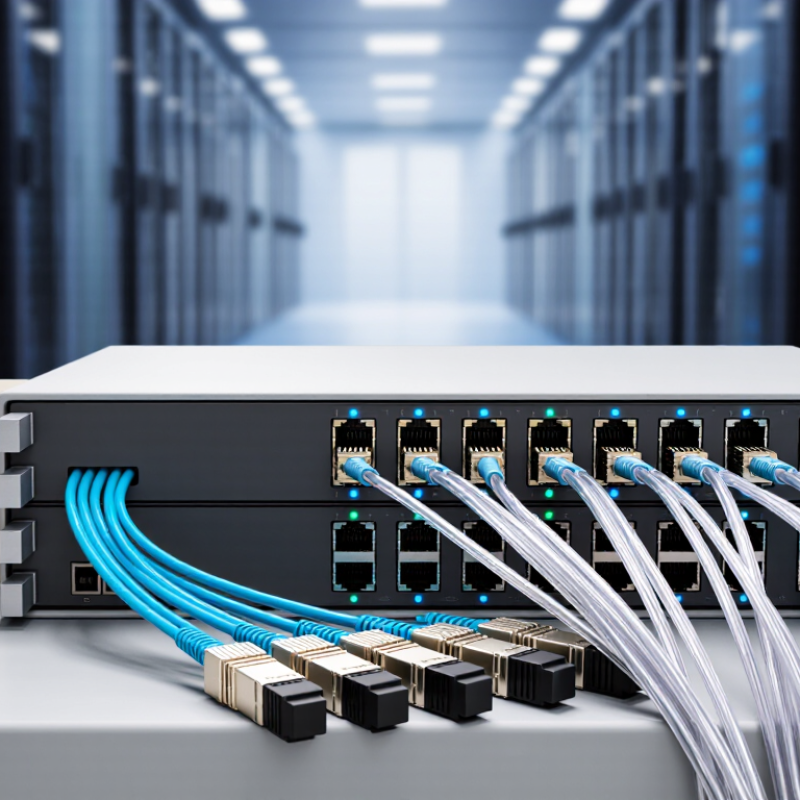
A 10G SFP+ AOC is a factory-terminated active optical cable. It combines two SFP+ transceiver ends with a fixed fiber cable. Unlike a passive copper cable, it uses optical signals for high-speed data transmission. Electrical signals enter one connector and reach an internal optical engine. The engine converts them into light pulses. At the opposite end, another engine converts those pulses back into electrical data.
The cable usually connects switches, servers, storage systems, or network appliances inside a data center. Its fixed construction reduces connector handling and often simplifies installation. In a rack test, the cable should click firmly into each port without excessive force. Check the required distance carefully. A 3-meter cable may suit one rack, while a 20-meter cable could support adjacent cabinets. Do not choose length by guesswork.
Global buyers should verify 10G Ethernet compatibility, SFP+ port support, and operating temperature. Optical performance can vary between short and long assemblies. Ask for test data, transmission specifications, and clear labeling on both ends. Country-specific packaging, documentation, and import requirements may also affect delivery. AOC selection is not always elegant. Some buyers focus only on price, then discover poor bend management or unclear port identification. A practical review should include cable routing, airflow, replacement access, and warranty terms. Even a reliable cable can fail when sharply bent or installed under tension.
| Data Dimension | Typical Specification or Fact | Why It Matters to Buyers |
|---|---|---|
| Product type | 10G SFP+ Active Optical Cable (AOC) | It is a factory-terminated cable assembly with an SFP+ optical module permanently attached at each end. |
| Nominal data rate | 10.3125 Gb/s for 10G Ethernet operation | Confirm that the switch, server adapter, storage device, or network appliance supports 10GbE and SFP+ interfaces. |
| Common Ethernet application | 10GBASE-SR and compatible short-reach 10GbE links | Check the equipment documentation for supported transceiver coding, link standards, and port restrictions before ordering. |
| Connector interface | SFP+ plug on both cable ends | The cable connects directly to SFP+ ports and normally does not require separate optical transceivers or LC patch cords. |
| Optical medium | Multimode optical fiber integrated inside the cable | AOC is designed primarily for short, high-density data-center and equipment-room connections. |
| Typical optical wavelength | Approximately 850 nm using short-wavelength optical transmission | This wavelength is commonly used for short-reach multimode 10GbE links; it is not intended for long-distance single-mode transmission. |
| Typical cable lengths | 1 m, 2 m, 3 m, 5 m, 7 m, 10 m, and selected designs up to approximately 30–100 m | Select the shortest practical length to improve cable management and airflow. Maximum reach depends on the cable design and application standard. |
| Transmission distance | Common data-center reach is 7–30 m; some AOCs support longer distances | Do not assume every 10G AOC has the same reach. Verify the specified maximum distance for the selected length and fiber construction. |
| Electrical-to-optical conversion | Each SFP+ end converts electrical 10Gb/s signals to optical signals and converts received optical signals back to electrical signals. | This integrated conversion eliminates the need to purchase and install separate optical modules at both ends. |
| Signal direction | Full-duplex transmission with one optical path for transmit and one for receive | Both connected devices can transmit and receive data simultaneously at 10Gb/s. |
| Power consumption | Typically low power per end; the exact value varies by length and design | Compare the specified maximum power with the host port budget, especially in dense server or switch installations. |
| Latency | Generally very low; the cable itself adds only a small propagation delay | AOC is suitable for server-to-switch, switch-to-switch, storage, and high-performance computing connections where low latency is important. |
| Cable construction | Lightweight fiber cable with integrated optical engines and strain-relief boots | The assembly is usually lighter and easier to route than many copper alternatives, but it should not be sharply bent or crushed. |
| Operating temperature | Commercial-temperature models commonly support approximately 0°C to 70°C; extended-temperature options may be available. | Choose an operating range suitable for the rack, industrial cabinet, telecom room, or outdoor enclosure. |
| Compatibility and coding | Compatibility can depend on SFP+ port requirements, EEPROM identification, firmware policy, and supported Ethernet standards. | Request compatibility confirmation or a test sample when connecting equipment from different manufacturers or system generations. |
| AOC versus DAC | AOC uses optical fiber; DAC uses twinaxial copper conductors. | AOC is generally lighter and supports longer short-reach links, while DAC is often preferred for very short connections and may have a lower purchase cost. |
| AOC versus separate transceivers and fiber | AOC combines two optical modules and a fixed fiber assembly into one tested product. | It simplifies installation and reduces connector points, but it offers less flexibility if the cable length or endpoint type changes later. |
| Testing and quality checks | Look for documented insertion loss, return loss, bit-error testing, temperature testing, and serial-memory verification. | Test records and traceability help reduce installation failures and simplify troubleshooting for international projects. |
| International purchasing checks | Confirm plug type, cable length tolerance, packaging, labeling, customs documentation, warranty terms, and regional compliance requirements. | Clear specifications reduce shipment delays, installation errors, and compatibility disputes across different markets. |